
Case study
Climate Resilience Capacity Building for Women in Poultry and Fish Farming, Bangladesh
Empowering women through climate smart agriculture and financial capability
Client: Asian Development Bank
Region: South Asia
Year: 2024
Prime Consulting Role: Programme implementation, workforce mobilisation, training delivery, monitoring and learning, partner coordination
Overview
In rural Bangladesh, climate volatility, animal disease risk and limited access to technical knowledge continue to constrain food security and women’s economic participation. Under Asian Development Bank Technical Assistance TA 6714 REG, Prime Consulting played a central role in translating a well designed programme into large scale, on the ground impact.
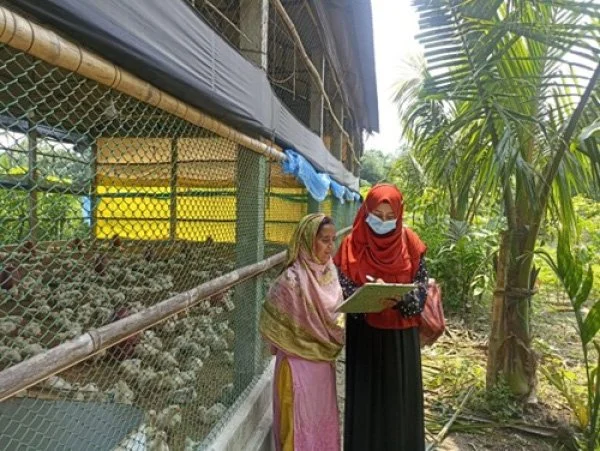
The project focused on strengthening climate resilience, livestock productivity and financial literacy among women engaged in poultry and fish farming. Using an exclusively female to female delivery model, the programme was designed to be culturally appropriate, locally trusted and practical to implement at scale.
Prime Consulting assumed responsibility for programme delivery in March 2024 and rapidly mobilised national teams to complete the majority of training activities. The result was a demonstrably effective intervention that exceeded training targets, delivered verified learning gains and left behind durable local capability.
The challenge
Women smallholder farmers in Bangladesh face intersecting challenges that limit productivity and income. These include climate related production shocks, disease risks, low access to veterinary and aquaculture advice, and limited financial literacy.
Cultural norms further restrict access to training and extension services, particularly where male trainers or mixed learning environments are involved. At the same time, donor funded programmes must deliver at scale, with consistent quality, within tight timeframes and across dispersed rural locations.
The challenge was not only to reach large numbers of women, but to ensure that training translated into measurable knowledge gains, practical behaviour change and sustained livelihood improvements.
The approach
Prime Consulting delivered the programme with a strong focus on ownership, responsiveness and delivery discipline.
A national network of female trainers was recruited, mentored and deployed across multiple farming zones, ensuring cultural fluency and trust at the community level. Training calendars were carefully sequenced to maximise coverage while maintaining quality and safety.
Rather than treating training as a one off activity, Prime Consulting embedded continuous learning and feedback loops throughout delivery. This included pre and post knowledge testing, participant feedback at every event, and post training follow up surveys to assess adoption and outcomes.
The team worked closely with cooperating partner New Hope Singapore, ensuring that trained farmers could access ongoing technical support and market pathways beyond the training period.
Lean field operations, strong logistics planning and hands on leadership enabled rapid mobilisation and adjustment as conditions evolved.
Delivery and outcomes
Across the full programme lifecycle, 9,035 women were trained, exceeding the original target of 9,000 participants.
Training delivery included:
5,414 women trained in poultry best practices
3,621 women trained in fish farming
9,035 women trained in financial literacy
328 training events delivered, with 201 conducted directly by Prime Consulting teams
Measured learning outcomes were exceptional:
Prior to training, only 15 percent of participants scored above 50 percent on technical knowledge tests
After training, 98 percent scored above 50 percent
Participant feedback confirmed high quality delivery:
100 percent reported satisfaction with training
59 percent rated technical content as excellent
71 percent rated overall training quality as excellent
95 percent reported increased knowledge
Six month follow up surveys demonstrated strong adoption:
92 percent reported increased production and income
87 percent of poultry farmers adopted biosecurity measures such as footbaths
85 percent of fish farmers adopted improved access controls
77 percent introduced pond netting and stock protection
Social and humanitarian impact
The programme delivered benefits well beyond technical skills.
At household level, women reported higher productivity, reduced mortality, improved income stability and stronger financial management. Many participants opened or began actively using bank accounts for the first time, linking agricultural gains with financial inclusion.
At community level, women increasingly took on decision making roles in farming activities, expanded enterprise scale and supported peer learning networks.
At institutional level, the programme demonstrated a scalable, replicable delivery model combining female led training, rigorous monitoring and strong partner integration.
The intervention strengthened food security, increased availability of animal protein, improved climate resilience of small farms and enhanced the economic agency of rural women.
Why it worked
The programme succeeded because Prime Consulting treated delivery as a shared responsibility rather than a transactional assignment.
Strong problem solving capability allowed the team to navigate logistical complexity and cultural constraints. Scale was achieved through trusted local networks and a blended delivery model. Flexibility and responsiveness ensured adaptation as field conditions evolved.
Crucially, Prime Consulting provided end to end capability, from mobilisation and training delivery through to monitoring, learning and partner coordination. Senior technical oversight ensured quality, while national teams ensured relevance and sustainability.
The result was not only a successful training programme, but a lasting capability embedded within communities.

Impact at a glance
9,035 women trained across poultry, fish farming and financial literacy
328 training events delivered across rural Bangladesh
98 percent post training knowledge proficiency, up from 15 percent baseline
92 percent reported income and production increases
87 percent adoption of poultry biosecurity practices
85 percent adoption of improved fish farming hygiene measures
Female to female training model enabling cultural acceptance and scale